

1000 pages. Redesigning trust at every touchpoint.
Role
Lead UX Designer
Timeline
14 months
Responsibilities
End-to-end Product Design, CRO

CONTEXT
One designer, two agency teams, a hard deadline,
and a brand people trust with their bodies.
Sono Bello is the nation's largest cosmetic surgery brand. As the only in-house product designer, I owned end-to-end design strategy and execution - setting direction for agency partners, aligning stakeholders, and connecting design decisions to business outcomes.
The core problem: Sono Bello needed to feel premium and trustworthy, but also approachable and non-intimidating. The redesign had to hold both - aspirational without being alienating to someone anxious about cost or eligibility.
BUSINESS GOALS
This wasn't just a facelift — it was a growth strategy
Lead Generation
Drive more form and live chat conversions from existing traffic.
Brand Credibility
Reflect Sono Bello's premium positioning; reduce trust friction.
SEO Discoverability
Restructure pages for crawlability and competitive rankings.
Reduce drop-off
Remove barriers, especially around cost and eligibility.
Accessibility
A legal and ethical requirement, not an afterthought.
Scalable Design System
Replace an aging site with a system that grows with the brand
KICKOFF
Two days, all the right people in one room,
and a shared language we used for 14 months
Before any wireframes, I organized a two-day workshop with stakeholders from marketing, brand, engineering, and both agency teams. Day one focused on alignment: auditing the existing site, reviewing business goals, and mapping the competitive landscape. Day two was about definition: co-creating design principles, running a content priority card sort, and establishing the page prioritization framework.
What we learned: Marketing saw users as aspirational buyers. Engineering saw them as form-fillers. Surfacing this tension in week one, before it became a design conflict mid-project, was the most valuable outcome of those two days.
CONTENT AUDIT
Before we could redesign anything, we had to decide what pages deserved to exist
The first major task was auditing 1,000+ pages. Working with agency partners, we evaluated every page across traffic volume, SEO keyword equity, conversion influence, and strategic business value.
SEO shaped every deletion decision. Canonical authority, redirect chains, and indexed keyword rankings were evaluated before any page was removed, reducing bloat without sacrificing organic visibility.
DISCOVERY
People aren't browsing for procedures.
They're searching for permission to feel good about themselves
Research included user interviews, surveys, persona development, Microsoft Clarity heatmapping, and an analytics deep-dive.
User Interviews - Explored decision journeys and trust signals. Most visitors had been considering a procedure for months before visiting the site.
User Surveys - Validated that cost clarity and procedure understanding were the two biggest barriers to booking.
Persona Development - Built personas around intent stages — early explorers vs. ready-to-consult — to inform content hierarchy and CTA strategy.
Heatmapping - Used Microsoft Clarity pre-launch on the existing site. Key finding: conversion-critical content was consistently below most users' scroll depth.
Analytics audit - Mapped traffic vs. CVR across the full site using Google Analytics. Procedures and Affordability pages had the clearest gap between visits and action.
"I kept going back but couldn't figure out if I was even a candidate. I just wanted someone to tell me yes or no."
Considering a procedure for 8 months
"The pricing page made me feel like I was about to get a car salesperson call. I just want to know if I can afford it first."
First-time visitor
"I trusted the reviews, but the site looked outdated."
Comparing Sono Bello to a competitor
RESEARCH FINDINGS, PROBLEM STATEMENTS, & HMW
Users weren't dropping off because they weren't interested —
they were dropping off because they weren't sure they belonged.
Six clear research findings emerged.
LEARNING 2
The site felt built for the ideal patient, not the user looking at it
The visual and content language spoke to an idealized patient rather than the real, diverse range of people considering a procedure, creating distance at the moment users needed to feel seen.
HMW design an experience that reflects the actual range of people Sono Bello serves?
LEARNING 1
Users couldn't self-qualify and left because of it
Users with genuine intent were self-eliminating before taking action because the site gave them no clear way to determine if a procedure was right for them. The existing "Am I a Candidate?" banner raised the question without answering it, adding anxiety rather than resolving it.
HMW help users might we design an experience where users arrive at their own answer?
LEARNING 3
Cost anxiety was the #1 exit point and the site was making it worse
Users who wanted to book were abandoning because the site treated cost as a secret to be revealed after commitment rather than information needed to make a decision.
HMW make cost feel like an answer rather than a barrier?
LEARNING 4
Users didn't understand what the procedure involved and uncertainty killed conversions
Information existed but was presented in clinical language that didn't map to the questions users were actually asking, "will it hurt?", "how long is recovery?", "will it work for me?"
HMW translate clinical procedure information into the language of real patient concerns?
LEARNING 5
80% of users were on mobile and the experience was broken
Despite the majority of users accessing the site on mobile, the existing experience was designed desktop-first and degraded significantly on smaller screens, creating friction at the most common entry point.
HMW design for the way most users actually experience the site, not the way we assumed they would?
LEARNING 6
The brand looked like it had fallen behind, eroding trust in the procedure itself
An inconsistent, visually dated site was undermining confidence in a brand asking users to trust it with a medical procedure, before users had read a single word of content.
HMW make the visual quality of the site match the quality of care Sono Bello delivers?
AI IN THE PROCESS
AI didn't replace the design work, it cleared the runway for it
Across a 14-month project with a single in-house designer, using AI tools strategically was how I maintained quality without sacrificing speed.
Research & Strategy - Claude & ChatGPT
-
Synthesized user interview transcripts and survey responses to surface recurring themes faster
-
Pressure-tested design decisions by simulating hesitant user responses before stakeholder reviews
-
Generated FAQ content from common patient search queries across every procedure page
Scale & Content - Claude & ChatGPT
-
Audited and categorized pages by traffic, conversion influence, and strategic value
-
Identified redundant and semantically similar pages as consolidation candidates
-
Generated redirect mapping recommendations based on page relationships and SEO equity
-
Rewrote clinical procedure descriptions into plain-language, outcome-led copy across hundreds of pages
-
Generated alt text for patient imagery at scale - a task that would have taken weeks manually
Design Ideation - Figma AI
-
Explored layout variations during early ideation before committing to wireframes
-
Accelerated component exploration across a large template library
-
Generated multiple CTA copy variants for A/B testing, giving the team real options rather than defaulting to one
The shift in how I work: AI handled the time-consuming groundwork: synthesis, first drafts, documentation. My focus stayed on the decisions that actually required design judgment. On a project this size, that distinction matters.
DESIGN STRATEGY
Mobile-first wasn't a preference, it was the only logical starting point
80% of Sono Bello's users accessed the site via mobile. Every design decision was made for a small screen first and scaled up to desktop. This shaped content hierarchy, CTA placement, form layout, and information architecture throughout.
How mobile-first showed up in the work: The sticky in-page nav on procedure pages exists because long-form content requires wayfinding on a small screen. The persistent "Questions? Call Us 24/7" bar exists because mobile users need a low-barrier exit that doesn't require scrolling. The single-CTA hero exists because competing CTAs on mobile create decision paralysis before the user has read anything.
Three principles, drawn directly from the research findings, guided every product decision: help users understand what a procedure is, show them it's within reach, and make the next step impossible to miss.
How this showed up in practice: CTAs moved from top-of-page defaults to moments of peak intent. Affordability content moved from buried footnotes to above-the-fold answers. Procedure pages led with outcomes, not clinical descriptions. Cost information was integrated directly onto procedure pages so users never had to navigate away.
BRAND & MARKETING COLLABORATION
The brand team held the vision. My job was to make sure the product didn't break it.
Marketing wanted the site to feel elevated and emotionally resonant. The product needed to be clear and frictionless. On a site where visitors often arrive anxious, those two goals pull in opposite directions.
Where we had to negotiate: Imagery choices that felt aspirational to marketing sometimes created distance for users already self-conscious. We developed a shared framework that both teams could work from: imagery that shows transformation without exclusion
ACCESSIBILITY
Due to the age demographic, accessible design was directly tied to conversion
WCAG 2.1 AA compliance was a hard requirement embedded into every design phase, not a final audit. Patients skewed older, a demographic more likely to rely on assistive technology and high-contrast modes. Accessible design here was directly tied to conversion.
LAUNCH APPROACH
Not all at once. A deliberate rollout, with room to learn as we went.
Pages went live in prioritized batches, highest-impact first. This kept risk low and generated real-world data before secondary pages launched.
-
Homepage
-
Procedure page
-
Affordability page
-
Procedure sub pages
-
Before & after gallery
High Impact
-
Locations
-
Safety
-
FAQs
-
Blogs
-
Patient Stories
Secondary
Live pages continuously improved via A/B testing in Convert and Clarity heatmaps, validating changes against real user behavior.
Post-launch Iteration
DESIGN DECISIONS
Every design decision traced back to trust
The redesign was built around a single organizing question: how do we make a hesitant, anxious user feel safe enough to take the next step? Every system-level and page-level decision answers that question differently.
+27%
Sitewide CVR within 3 months
19/20
Top pages improved in CVR
+27%
Page-one keyword rankings
98
Brightedge score
OLD HERO SECTION
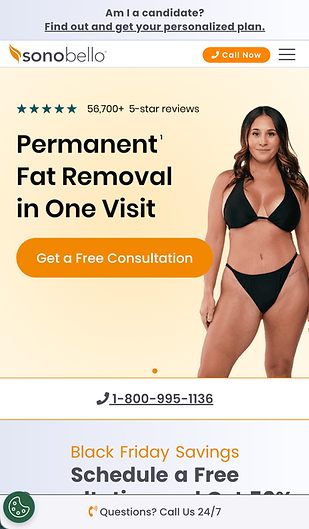
NEW HERO SECTION

Trust signals before the form.
Old: "Am I a Candidate?" banner at the top, full-screen promotional form immediately below the hero, no benefit context before the ask.
New: Outcome-first headline (Permanent Fat Removal in One Visit), social proof above the headline, single "Get Started" CTA.
Homepage
+17% CVR
OLD CONSULTATION FORM

NEW CONSULTATION FORM

Urgency language doesn't work when the decision is this personal.
Old: Urgency language "Schedule a Free Consultation and Get 50% Off Your First Area!" as the form heading causing users to feel pressure to book and causing drop off.
New: Form appears after content, headed with a contextual message tied to the current seasonal event. Placeholder text humanized. Also, less urgency. Cosmetic surgery users cannot be pressured to move faster than their timeline.
Affordability page
+64% CVR
OLD HERO SECTION

NEW HERO SECTION

Earn their trust before asking to commit.
Old: Old mobile affordability led with two competing CTAs ("Save Now" and "Financing Options"), no imagery, and a promotional section - all before a single piece of pricing information appeared.
New: Single "Get Started Today" CTA, patient photo, then five trust signals immediately below fold. Entirely absent from the old page. Earn their trust before the ask, not after it.
OLD PRICING MODULE

NEW PRICING MODULE

More transparency about how pricing is determined.
Old: "How do we calculate cost?" with bare text labels.
New: Stacked full-width Pricing Factor cards on mobile (Body Mass Index, Treatment Areas, Seasonal Promotions), each with real photography and explanatory copy on pricing determination.
NEW HERO SECTION
OLD HERO SECTION
Procedure page
+75% CVR


Patients search for outcomes, not procedure names
Old: Procedure logo (TriSculpt) as the dominant element above the fold, clinical copy below the fold.
New: Outcome-first headline ("Say Goodbye to Stomach Fat"), social proof above the headline, and a single CTA. Procedure name moved out of the way so the user's questions can come first.
OLD BENEFITS SECTION

NEW BENEFITS SECTION

Scannable benefits sections outperform dense clinical cards on mobile.
Old: Three dense clinical cards (Comfort, Remove, Refine) stacked vertically, each requiring significant scroll to read.
New: New section is broken into scannable modules (Targeted Fat Removal, Minimally Invasive, Fast Recovery, Permanent Results), each with a supporting image and a specific CTA. Designed to be read in short sessions.
How iteration worked post-launch: A/B tests in Convert ran continuously on live pages; CTA copy, content order, layout variants. Winning variants informed the next round. Clarity heatmaps validated hierarchy changes. Launches were the start of a feedback loops.
OUTCOMES
Launched two weeks early. The site held up when it mattered most.
Launched mid-November 2025, two weeks ahead of the Black Friday target. Despite holiday seasonality and industry headwinds, improved conversion efficiency offset the expected drop in lead volume.
+27%
Sitewide CVR within 3 months
19/20
Top pages improved in CVR
+20%
Page-one keyword rankings
98
Brightedge score
The bigger signal: The +27% CVR lift happened during the industry's slowest season, with less traffic, more economic pressure, and multiple Google algorithm updates mid-launch. What the numbers look like in peak season is the real opportunity.
REFLECTION
What I'd do differently and what I'm proud I fought for
If I were starting over, I'd push harder for a more phased documentation system from day one, a living source of truth that captured decisions and rationale as they were made. Over 14 months, context gets lost, and I often relied on my own memory to bridge gaps.
What I'm proud of: the zero-regression launch. When you're coordinating multiple teams across a year-long project on a high-stakes consumer site, getting to launch day without a single critical UX issue is the result of deliberate process, not luck. That discipline — QA reviews, staged rollouts, pre-launch checklists — was something I built and owned.